



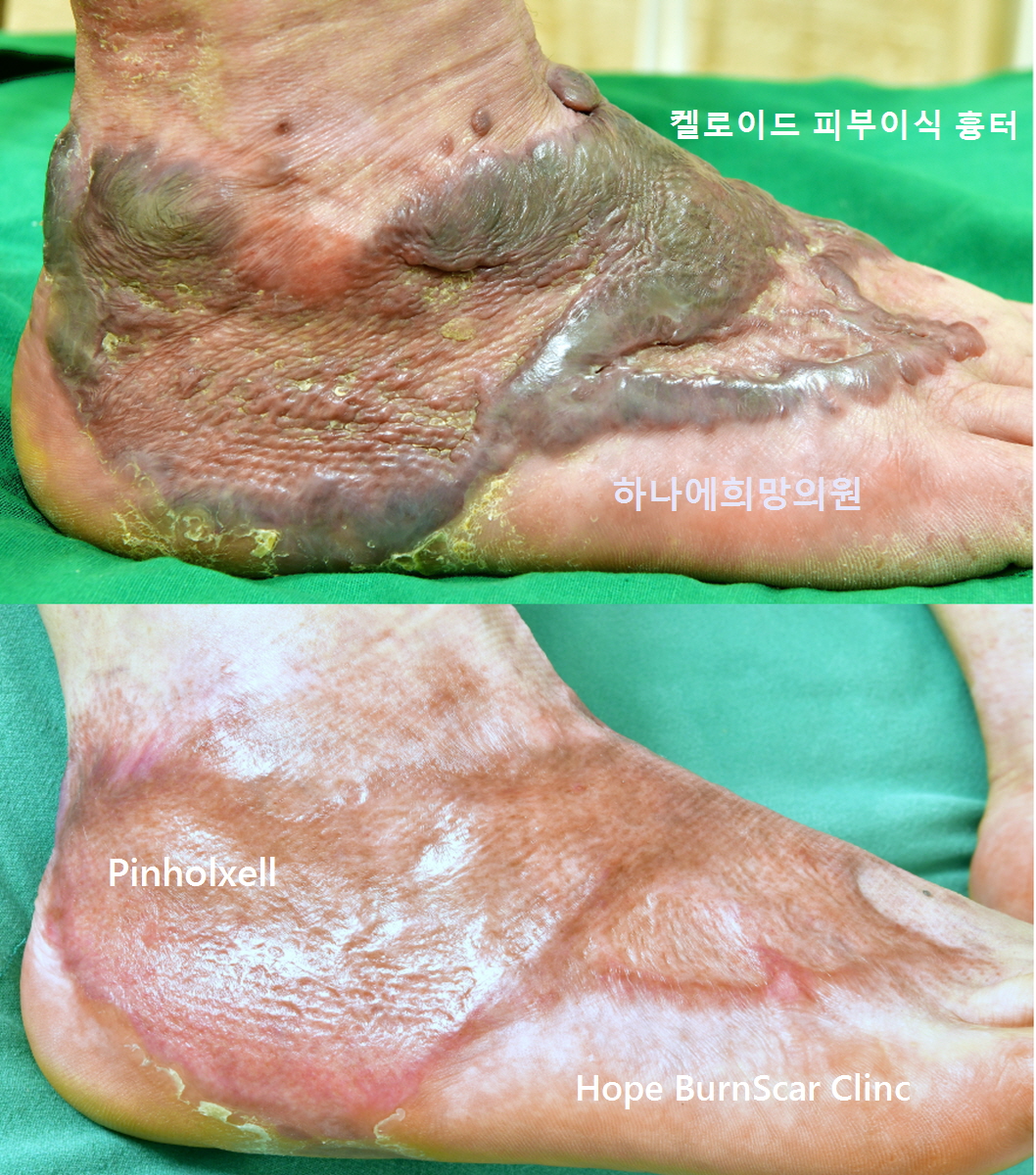
A 67-year-old male presented with early hypertrophic and keloid scarring 4 months after undergoing a skin graft
for a chemical burn sustained 5 months prior. The graft site, located on the lateral aspect of the foot and ankle,
exhibited raised, darkly pigmented keloid tissue with irregular texture, surface scaling, and prominent nodular borders.
The patient experienced severe pruritus, persistent pain, and difficulty walking due to tissue tightness and
contracture at the ankle joint.
Total treatment time was 18 month
• The pigmentation of the scar significantly normalized. The previously dark violaceous and
reddish discoloration
diminished, blending more seamlessly with the surrounding skin.
• There was a marked reduction in scar thickness and protrusion. The previously elevated, nodular
keloidal margins flattened
considerably, resulting in a more even surface contour.
• The texture of the skin improved noticeably. The rough, scaly, and irregular surface observed
before treatment became smoother, with improved
elasticity and a healthy sheen.
• Subjective symptoms, including persistent itching and pain, were fully relieved.
The patient reported no discomfort during rest or
ambulation following treatment.
• Functional recovery was also observed. The initial gait disturbance caused by contracture and
scar tightness around the ankle was
resolved.
The patient regained the ability to walk unaided, indicating a significant improvement
in mobility and joint flexibility.
When keloid formation accompanies the early stage of skin graft healing, the treatment
becomes significantly more complex. The symptoms and scar thickness tend to fluctuate,
alternating between improvement and worsening. However, with careful and experienced
clinical judgment, timely interventions have been made, allowing the patient to recover
steadily without complications.
Pre- and post-treatment images are displayed in figure.
 82+)
82+)


 다음글
다음글
 이전글
이전글